Sustainability measured, not declared
Two EPD environmental product declarations
We hold two Type III environmental product declarations issued by the Building Research Institute (ITB) — a programme operator belonging to the European ECO Platform. Both were prepared in accordance with EN 15804+A2 and independently verified to ISO 14025.
Declaration ITB-EPD 561 covers precast elements in normal-weight concrete classes C20/25, C30/37, C35/45 and C45/55. Declaration ITB-EPD 562 covers expanded clay (LECA) concrete products in classes from LC12/13 D1,4 to LC20/22 D2,0.
The analysis covers modules A1–A3 (product), A4 (transport to the construction site), C1–C4 (end of life) and module D, i.e. benefits beyond the system boundary resulting from recycling. The declared service life is 50 years.
What the declarations are based on
Both declarations were prepared under the same rules, so their results can be compared directly.
ITB-EPD 561 · ITB-EPD 562 · EN 15804+A2 · ISO 14025 · eco-platform
- Programme operator
- Building Research Institute (ITB)
- Standard
- EN 15804+A2, verified to ISO 14025
- Product category rules
- ITB-PCR A
- Declared unit
- 1 tonne of product
- Scope of analysis
- A1–A3, A4, C1–C4 and module D
- Service life
- 50 years
- Data representativeness
- Poland, 2023
- Validity
- Until 1 December 2028
- Comparing data from different declarations is only meaningful when all of them were prepared to the same EN 15804+A2 standard.
- The calculations use a Polish electricity emission factor of 0,702 kg CO₂/kWh (Ecoinvent 3.9.1 supplemented with KOBiZE data).
Declarations in the ITB register
Both declarations are published in the public register of the Building Research Institute (ITB). An LCA verifier can download them straight from there without asking the manufacturer.
Environmental declarations are one part of the compliance file — standards, factory production control certificates and declarations of performance are listed on Compliance and certificates.
- NumberITB-EPD 561/2023
Prefabricated concrete products — normal-weight concrete precast
- Scope
- C20/25, C30/37, C35/45, C45/55
- Issued
- 1.12.2023
- Valid until
- 1.12.2028
- NumberITB-EPD 562/2023
Prefabricated products of expanded clay concrete — LECA concrete precast
- Scope
- LC12/13 D1.4 – LC20/22 D2.0
- Issued
- 1.12.2023
- Valid until
- 1.12.2028
How much CO₂ per tonne of product
Global warming potential (GWP) values in kg CO₂ eq per 1 tonne of product, broken down by life-cycle module. Module D is negative because it describes the benefits of recycling concrete and steel beyond the system boundary.
| Life-cycle module | Normal-weight concrete | Expanded clay concrete |
|---|---|---|
| A1 — raw materials | 171 | 230 |
| A2 — raw material transport | 25,0 | 22,1 |
| A3 — manufacturing | 42,5 | 42,3 |
| A1–A3 — product total | 239 | 295 |
| A4 — transport to site | 83,4 | 83,4 |
| C1–C4 — end of life | 38,0 | 38,0 |
| D — recycling benefits | −30,9 | −30,9 |
Per tonne or per cubic metre?
Per tonne, expanded clay concrete comes off worse: 295 versus 239 kg CO₂ eq, because producing expanded clay aggregate is energy-intensive. That comparison is misleading, however, because the two materials have different densities.
The declarations state an average density of 2330 kg/m³ for normal-weight concrete and 1870 kg/m³ for expanded clay concrete. Converted to a cubic metre, that gives around 557 kg CO₂ eq for normal-weight concrete and around 552 kg for expanded clay concrete — practically the same.
The real difference only appears at the level of the building envelope. Expanded clay concrete conducts heat less than half as well, so the same insulation performance needs a thinner insulation layer, and a lighter element means fewer transport runs and lower loads on the foundations.
Values per cubic metre are converted from the declared unit (1 tonne) using the declared average density. The declarations themselves state values per tonne only.
What the EPD does in a project
An environmental declaration is not a marketing document. It is input data for a calculation that is increasingly run by the certifier, the bank or the taxonomy auditor. Without it, the designer falls back on generic database values, usually higher than those measured for a specific plant, and the investor loses points that did not have to be lost.
An example on a single wall: a 10 cm wall of LC12/13 expanded clay concrete weighs 140 kg/m², so its footprint in modules A1–A3 is around 41 kg CO₂ eq per square metre. A 20 cm wall of normal-weight concrete weighs around 466 kg/m² and gives around 111 kg CO₂ eq. This is a conversion from the per-tonne value, not a separate measurement, but it is enough to compare structural options at concept stage before anyone models the whole building.
A full building balance also needs the remaining indicators of the declaration, such as primary energy demand, acidification and eutrophication, and all of them are in the documents available for download below. On request we prepare a list of the project's elements with assigned mass and GWP result, ready to paste into an LCA tool.
Where the declaration becomes a number in a document
Four places where the auditor asks for the product EPD rather than for manufacturer claims.
BREEAM
The Materials category rewards a building life cycle assessment and the share of products with Type III declarations verified to EN 15804. Our declarations were issued under the ITB programme, a member of eco-platform, so the assessor accepts them without additional verification.
LEED
The Building Product Disclosure and Optimization credit counts products with EPDs. A product-specific declaration to ISO 14025 and EN 15804 counts as a whole product, whereas an industry-wide declaration counts as half.
DGNB
Criterion ENV1.1 requires a life cycle assessment of the whole building. Manufacturer data replaces the generic values from the Ökobaudat database, which usually improves the result because generic values are calculated with a safety margin.
EU Taxonomy and EPBD
For new buildings above 5,000 m² the Taxonomy requires a life-cycle global warming potential calculation. The 2024 EPBD extends this duty to buildings above 1,000 m² from 2028 and to all new buildings from 2030. The calculation needs data per product, which means EPDs.
Where these numbers come from
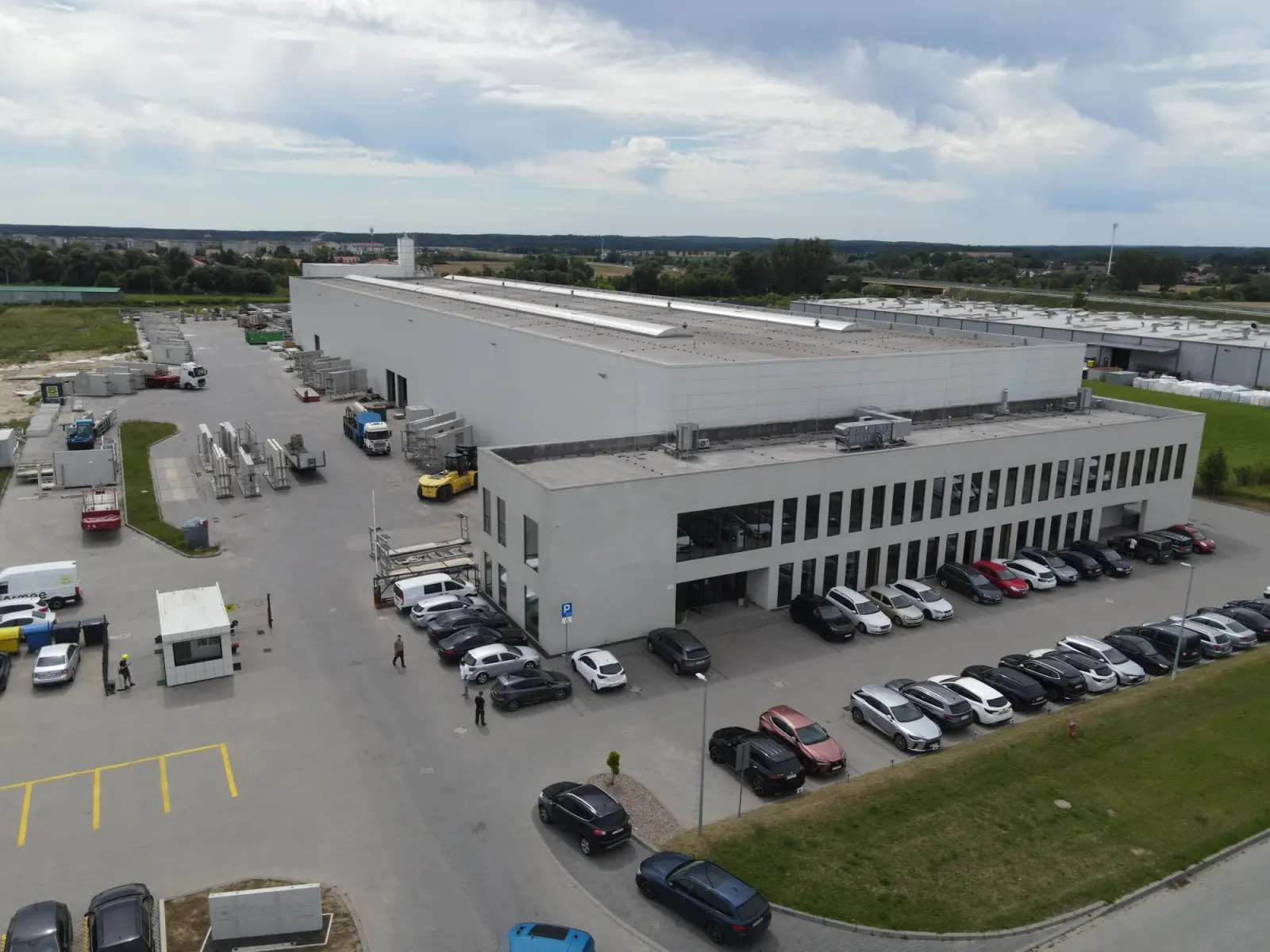
The result for module A3 depends on how production is organised. The plant in Międzyrzecz is one of the newest in Poland and was designed for automation and a closed material loop.
35 000 m³ a year
The plant's production capacity is 35 000 m³ or 200 000 m² of precast elements a year.
Four production lines
Separate lines for walls, balconies and flat elements, for columns and beams, an automated stair line and an automated reinforcement line.
Concrete recycling
The plant is equipped with pioneering systems for concrete production, distribution and recovery, and with a steel mesh welding line.
BIM reduces waste
Process automation combined with BIM optimises production and reduces the amount of post-production waste.
Need the declarations for your LCA calculations?
We provide the full ITB-EPD 561 and 562 declarations with a complete set of environmental indicators — for use in building LCA analyses, BREEAM, LEED or DGNB certification, and EU taxonomy reporting.