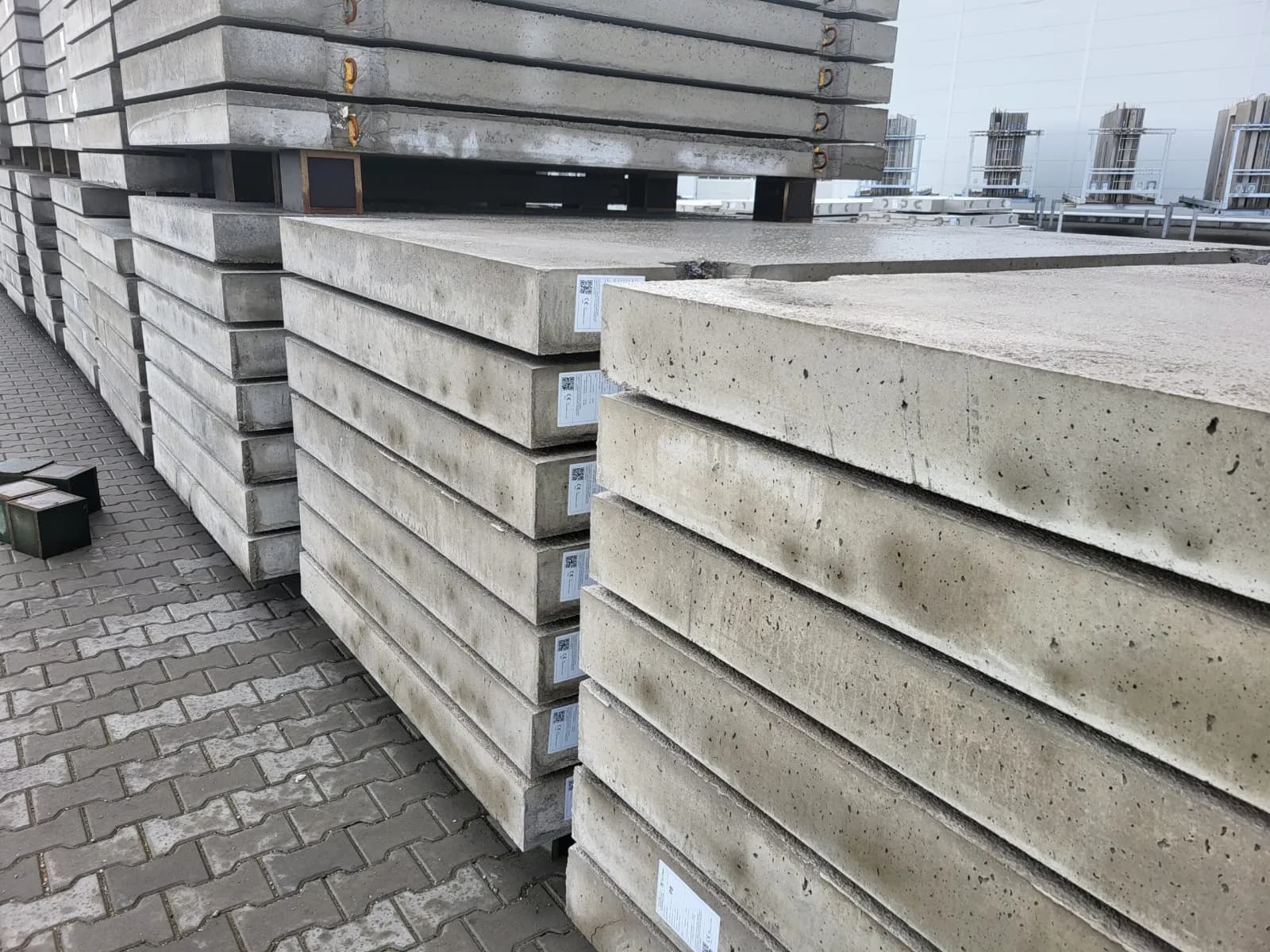
Concrete road plates a surface made of precast
A road surface you can move
A precast road plate replaces a surface cast in place. Laid on a prepared subbase it takes traffic straight away — there is no curing period during which the area stays closed.
We produce the full typical range of solid plates: STANDARD with a wheel load up to 30 kN, reinforced up to 50 kN and heavy with a declared class of 120 kN. The lighter variants follow the catalogues of repeatable road elements — C30/37 concrete, F150 frost resistance, W6 water tightness. The heavy variant has its own declared values: C25/30 concrete, double ⌀6 reinforcement and water absorption up to 5%, which matters through freeze–thaw cycles.
The solution proves itself on temporary surfaces — haul roads, site compounds, diversions — because the same plates can be lifted afterwards and reused. They serve equally well as a permanent surface for storage yards and parking areas.
In enquiries the product appears as a road plate, a concrete road slab or a temporary roadway plate.
Road plate parameters
Values declared in national declaration of performance 06/26. The product carries the B construction mark.
B construction mark · C25/30 · 120 kN
- Dimensions (l × w)
- 3000 × 1500 / 3000 × 1200 / 3000 × 1000 mm
- Thicknesses
- 150 / 180 / 200 mm
- Wheel load
- ≤ 30 / ≤ 50 / 120 kN, by variant
- Concrete compressive strength
- C30/37 · C25/30 (120 kN variant)
- Weight of a 300 × 150 × 15 cm plate
- approx. 1600 kg · 1750 kg (120 kN variant)
- Reinforcement
- By variant — see the variants table
- Water absorption
- Up to 5%
- Abrasion resistance
- 18 000 mm³/5000 mm²
- Marking
- B construction mark
- Abrasion resistance does not apply to elements intended for permanent surfaces.
- Bearing capacity also depends on the strength and evenness of the subbase — the plate alone cannot compensate for a poorly prepared foundation layer.
Solid plate variants
The STANDARD and reinforced variants follow the catalogues of repeatable road elements used across the industry — which is why their parameters coincide between producers. The heavy variant has values declared in the National Declaration of Performance, and we quote them unchanged.
| Parameter | STANDARD | Reinforced | Heavy (120 kN) |
|---|---|---|---|
| Wheel load | ≤ 30 kN | ≤ 50 kN | 120 kN |
| Concrete class | C30/37 | C30/37 | C25/30 |
| Reinforcement | approx. 25.5 kg B500SP | approx. 36 kg B500SP | ⌀6 bar, 32 kg |
| Weight | approx. 1600 kg | approx. 1600 kg | 1750 kg |
| Frost resistance / water tightness | F150 / W6 | F150 / W6 | absorption ≤ 5% |
| Typical use | pedestrian and car traffic | vans, lighter machinery | construction and heavy traffic |
Where road plates are laid
The declared use covers permanent and temporary surfaces. The thickness variant follows the expected traffic.
Access and haul roads
Site access and working roads carrying heavy vehicles. Once the project ends the plates move to the next site.
Storage yards
A surface for material storage and handling equipment, resistant to point loads.
Parking areas
Parking bays and manoeuvring areas where handing the surface over quickly is what matters.
Streets and diversions
Temporary carriageways during reconstruction, laid and removed without wet trades.
What determines the price of precast elements
Precast elements are not priced from a per-metre price list — every element is designed for a specific project, and the difference between two projects of the same floor area can reach several tens of percent. So instead of a rate, we explain what actually determines the figure in your offer.
We prepare a quote within about a week of receiving complete documentation: dimensioned floor plans, sections, elevations and the site location with a postcode. The offer covers production, transport and installation — each item is priced separately, so you can see where there is room for savings.
- Element repeatability
- The single biggest variable. The same element produced in a series is markedly cheaper than a one-off, because the mould and production set-up are spread across many casts. A design based on a few repeatable types works out cheaper than one with dozens of unique elements.
- Concrete class and reinforcement
- A higher class means more cement; higher loads mean more steel. Sizing for the actual loads, rather than with excess margin, can cut the cost without compromising the structure.
- Surface finish
- A smooth, as-cast surface from the mould is standard. Form-liner textures, acid etching or architectural concrete in category BA2 or BA3 require additional formwork and tighter controls, which shows in the price.
- Factory-fitted features
- Cast-in boxes, conduits, openings and corbels increase the element price but remove the cost of chasing and fixing on site. On larger series this usually works out cheaper than doing the work on site.
- Transport and size
- The price depends on the distance and the number of loads. Elements up to 3,85 × 9,00 m travel on a standard vehicle; larger ones require abnormal-load transport with an escort vehicle and permits, which changes the calculation significantly.
- Timing and season
- Production runs in parallel with the groundworks, so ordering early gives flexibility in the programme. Forced deadlines and next-day deliveries always cost more.
Concrete road plates — questions
The questions contractors and site managers ask most often. Yours is not here? Write to us — we'll give you a straight answer.
- What sizes do road plates come in?
- We produce plates measuring 3000 × 1500 mm in two depths: 150 and 180 mm. The 15 cm version weighs 1750 kg and is the standard solution for haul roads and yards; the 18 cm version is used where loads are higher or the subgrade weaker. Both carry a load class of 120 kN.
- What load classes do road plates come in, and which one to choose?
- The market splits plates into three groups by permissible load, stated as a concentrated force: light — around 30 kN, for pedestrians, pallet trucks and cars; medium — around 50 kN, for vans and lighter machinery; and heavy, the so-called MON plates — from 120 kN upwards, for construction traffic and heavy transport. When comparing offers, watch the units: some producers quote a load per square metre or a vehicle tonnage, which cannot be compared directly with a concentrated force. Even a single documentation set can mix them: the instructions may state a wheel load of P ≤ 30 kN while the drawing of the same plates says 30 kN/m². Our heavy plate has a declared class of 120 kN; the STANDARD and reinforced variants are in regular production — their parameters are set out in the variants table on this page.
- What types of road plates are there?
- The market offers solid rectangular plates, perforated grass plates and shaped units for slope protection. We produce solid plates in three load variants as well as perforated JOMB-type plates of 100 × 75 × 12.5 cm. The heavy solid plate is made in C25/30 concrete, with double reinforcement of ⌀6 bars at 32 kg per plate, water absorption up to 5 % and abrasion resistance of 18 000 mm³/5000 mm². The product carries the Polish construction mark B.
- How are road plates laid?
- The durability of the surface is decided by the sub-base, not by the plate itself. The subgrade has to be profiled, compacted and drained — usually on a layer of mechanically stabilised aggregate levelled with a bedding course. Plates are laid with a crane or loader and lifting gear, butted together, with movement joints and in a bond so the joints do not form a continuous line. A plate laid on uneven ground works at its edges and cracks, which makes screeding the bedding more important here than the speed of laying.
- How much does a 300 × 150 × 15 cm road plate weigh?
- 1750 kg, of which 32 kg is reinforcement. This matters when choosing unloading equipment and calculating the load per lorry — a standard rig takes a dozen or so plates, depending on the permissible gross weight.
- Can the plates be reused?
- Yes, and that is their main advantage for temporary surfaces. The plate is lifted by its transport anchors and moved elsewhere. Wear is limited to edges and corners, provided the ground was level.
- What ground preparation is required?
- A levelled and compacted sub-base with a bearing capacity matching the expected traffic. The plate spreads the load but does not replace the sub-base — on uneven ground it bends in a way the calculations do not allow for.
- What is the difference between the 15 and 18 cm versions?
- The thicker version is used where heavy traffic is more intense and the sub-base weaker. We confirm the choice against the expected loads — the declared load class is 120 kN.
Documents for this product
Technical catalogue, installation manual, declaration of performance and FPC certificate — what design and handover call for.
- Product tolerances
Permissible dimensional and geometric deviations and surface requirements for precast elements, arranged by product standard: wall elements EN 14992, ribbed floor elements PN-EN 13224, linear elements PN-EN 13225 and others. The basis for accepting elements on site. Version 2026-02, contract annex, in force from 1 January 2026. Document in Polish.
PDF · 7 pages · 0.2 MB
- General installation conditions (OWM)
Scope of the standard installation service and additional works, performance conditions, preparation of the work front, setting out, substrate and access routes, interruptions and standstills, and acceptance. Version 2026-02, in force from 1 January 2026. Document in Polish.
PDF · 8 pages · 0.6 MB
- NORDCERT certificate — precast concrete products (EN 13369)
Certificate no. 2284 issued by Nordcert AB, Stockholm, for the factory production control of precast concrete products group B to EN 13369:2018 with supplementary Swedish requirements (Nordcert CB5). Authorises use of the BBC mark. Międzyrzecz plant, identification PO 24, valid until 31 December 2027.
PDF · 1 page · 0.6 MB
- NORDCERT certificate — ready-mixed concrete (EN 206)
Certificate no. 7316 issued by Nordcert AB, Stockholm, for the production of ready-mixed concrete to EN 206:2013+A2:2021 and DS/EN 206 DK NA:2020. Międzyrzecz plant, valid until 31 December 2027.
PDF · 1 page · 0.04 MB
- Certificate ITB-EPD 561/2023 — normal-weight concrete precast elements
Type III environmental product declaration certificate issued by the Building Research Institute (ITB) in accordance with EN 15804+A2. Issued 1 December 2023, valid for 5 years.
PDF · 1 page · 0.2 MB
- Certificate ITB-EPD 562/2023 — expanded clay concrete precast elements
Type III environmental product declaration certificate for lightweight concrete products, in accordance with EN 15804+A2. Issued 1 December 2023, valid for 5 years.
PDF · 1 page · 0.2 MB
Guides
More about this product
Articles on the decisions that precast takes before production rather than on site.
We'll select the right elements for your project
Send us dimensioned floor plans, sections and elevations — we will prepare an element selection, a schedule and a quote. Preparing a quote takes around a week on average. We deliver and install across Poland as well as in Germany, Czechia, Slovakia, Denmark and Sweden.