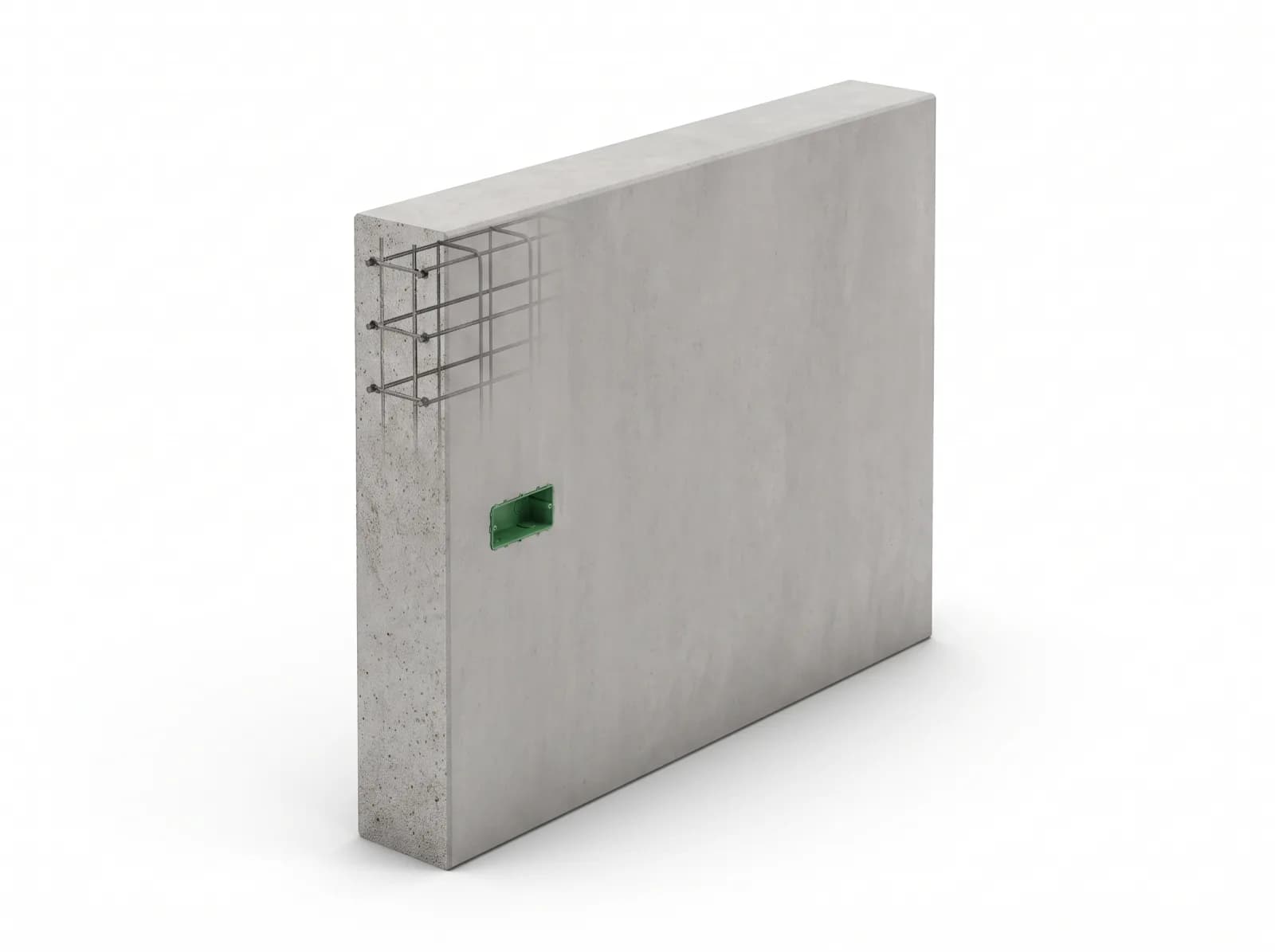
Guides
A LECA concrete house — pros and cons
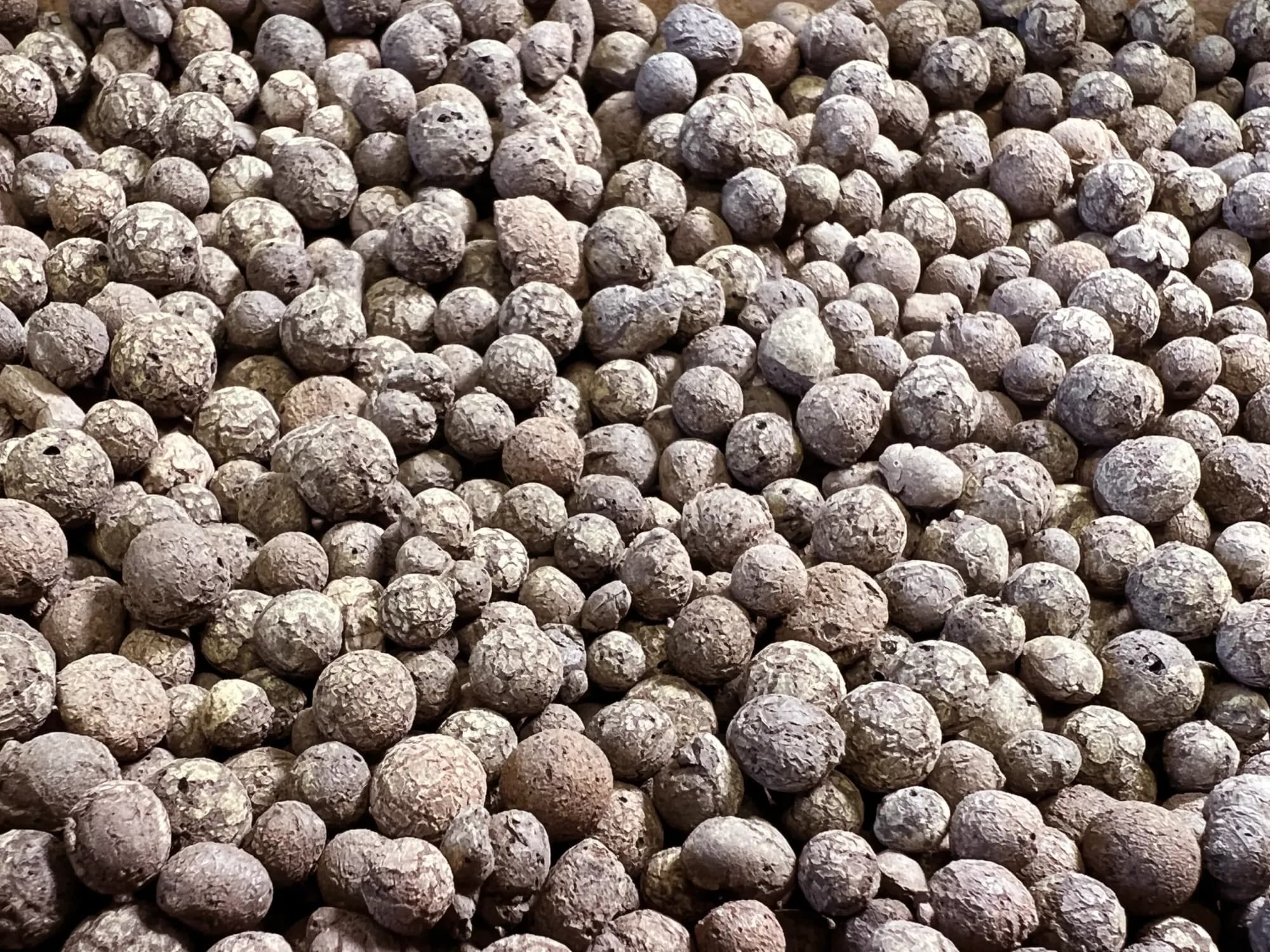
A manufacturer rarely starts with the drawbacks, so let us start with them. Expanded clay concrete has three limitations that are worth knowing before choosing the technology — and none of them is a reason to abandon it. They are, however, a reason to know where to use this material and where to reach for normal-weight concrete.
This text takes both directions apart: first the limits of lightweight concrete, then its advantages, and finally the practical selection criterion. All the figures refer to precast walls in expanded clay concrete, not to masonry blocks — these are two different products, even though the material shares a name.
Drawback one: shrinkage
This is the limitation that makes itself felt most in practice. Lightweight concrete shrinks by up to 0.8‰ as it dries, while normal-weight concrete shrinks by 0.3–0.5‰. Three things are responsible at once: the porous cement paste, the voids between aggregate granules, and the low modulus of elasticity of expanded clay, which stiffens the concrete matrix less effectively.
The result can be vertical shrinkage cracks in the wall and at the joints between elements. They usually have no effect on load-bearing capacity, but they have to be allowed for in the finish — and this is where the most common mistake occurs: skipping the drying stage. The guidelines of the Letbetonelementgruppen state that roughly half of the shrinkage should have developed before painting and tiling. At relative humidity up to 30% and 18–20°C this usually takes 4–6 weeks, and longer for thicker walls.
Here is how it is done: the element joints and corners are reinforced beneath the coating with 100 mm strips of glass fleece, the whole wall is covered with wallpaper, fleece or reinforcing felt, and a flexible adhesive able to take small differential movements is used under tiles.
There is a consolation here that is rarely mentioned: in lightweight concrete, shrinkage ends together with drying. In normal-weight concrete the final shrinkage appears only after 1–5 years — that is, long after somebody has moved in.
Drawback two: lower compressive strength
We produce expanded clay concrete in classes from LC12/13 to LC20/22. Normal-weight concrete starts at C20/25 and goes higher. Under large concentrated loads — beneath a long-span downstand beam, at the bearing of a steel structure — the design therefore returns to normal-weight concrete.
In a single-family house this limitation rarely becomes active, because the loads from the floors and roof are distributed along the whole length of the wall. It does become active in taller buildings and in industrial facilities, and there the decision is taken for a particular element, not for the whole building.
Drawback three: acoustics at the same thickness
This one is the most often misunderstood, because intuition suggests that a porous material must attenuate better. The opposite is true: sound insulation is governed above all by surface mass, and lightweight concrete is by definition lighter.
The figures: a 100 mm wall in class LC16/18 gives Rw 41.5 dB, the same thickness in C20/25 concrete already gives 47.9 dB. Six decibels of difference is a lot.
The qualification matters, though — the comparison only makes sense at the same thickness. In laboratory measurements a 180 mm wall in class LC16/18 achieved 55 dB, one decibel more than 160 mm of normal-weight concrete. For party walls, where acoustics decide the matter, one simply selects a thicker element. What is worth knowing, on the other hand, is that moving from LC16/18 to LC20/22 does not change the rating — denser lightweight concrete is chosen for load-bearing reasons, not acoustic ones.
Advantage one: weight
A 100 mm wall in class LC12/13 weighs 140 kg/m². The same wall in C20/25 concrete weighs 235 kg/m². That is almost 100 kg on every square metre of wall.
The consequences run through the whole project: lighter foundations, fewer deliveries to site, a smaller crane, a shorter erection cycle. In a multi-storey building there is also the reduced load on the structure of the lower floors.
Advantage two: warmth
The thermal conductivity of expanded clay concrete is 0.9–1.1 W/(m·K) against 2.0 W/(m·K) for normal-weight concrete. The material nevertheless remains structural rather than insulating — in an external wall it works together with the insulation layer in any case.
The gain lies elsewhere: the structure itself cools the element less, and thermal bridges are easier to eliminate. A finished wall in class LC16/18 achieves a thermal transmittance of 0.165 W/(m²·K) with 200 mm of mineral wool and 0.117 W/(m²·K) with 180 mm of resol foam. The Polish technical requirements WT 2021 call for no more than 0.20 W/(m²·K) for external walls — both values meet that with a margin.
Advantage three: fire and durability
Expanded clay concrete is non-combustible — in the European reaction-to-fire classification this corresponds to class A1, a material that does not take part in a fire and does not give off smoke. The porous aggregate conducts heat more slowly than natural aggregate, so the cross-section heats through later. Our layered walls have a declared fire resistance of R60–R240 and EI30–EI60.
Durability is the same as for normal-weight concrete. Eurocode EN 1990 assumes a design working life of 50 years for buildings, and with a correctly chosen exposure class and concrete cover a reinforced concrete structure works longer. The material is resistant to water and frost — it does not rot and does not lose its properties.
The selection criterion
It comes down to a single question: what matters more in this particular element — warmth and mass, or strength and acoustics?
The external and internal walls of a single-family house gain from lightweight concrete, because they work across their whole area and because they govern the building's thermal balance. Party walls in a multi-family building and locations with large concentrated loads gain from normal-weight concrete.
In practice a house is built from both materials at once, and there is no contradiction in that. We produce floors, stairs and balconies in normal-weight concrete up to class C35/45 precisely because they are slender and heavily loaded — there it is the strength of the section that decides, not the reduction in weight.
More about the material itself, its classes and properties: expanded clay concrete. About how a building is made from it: our services.