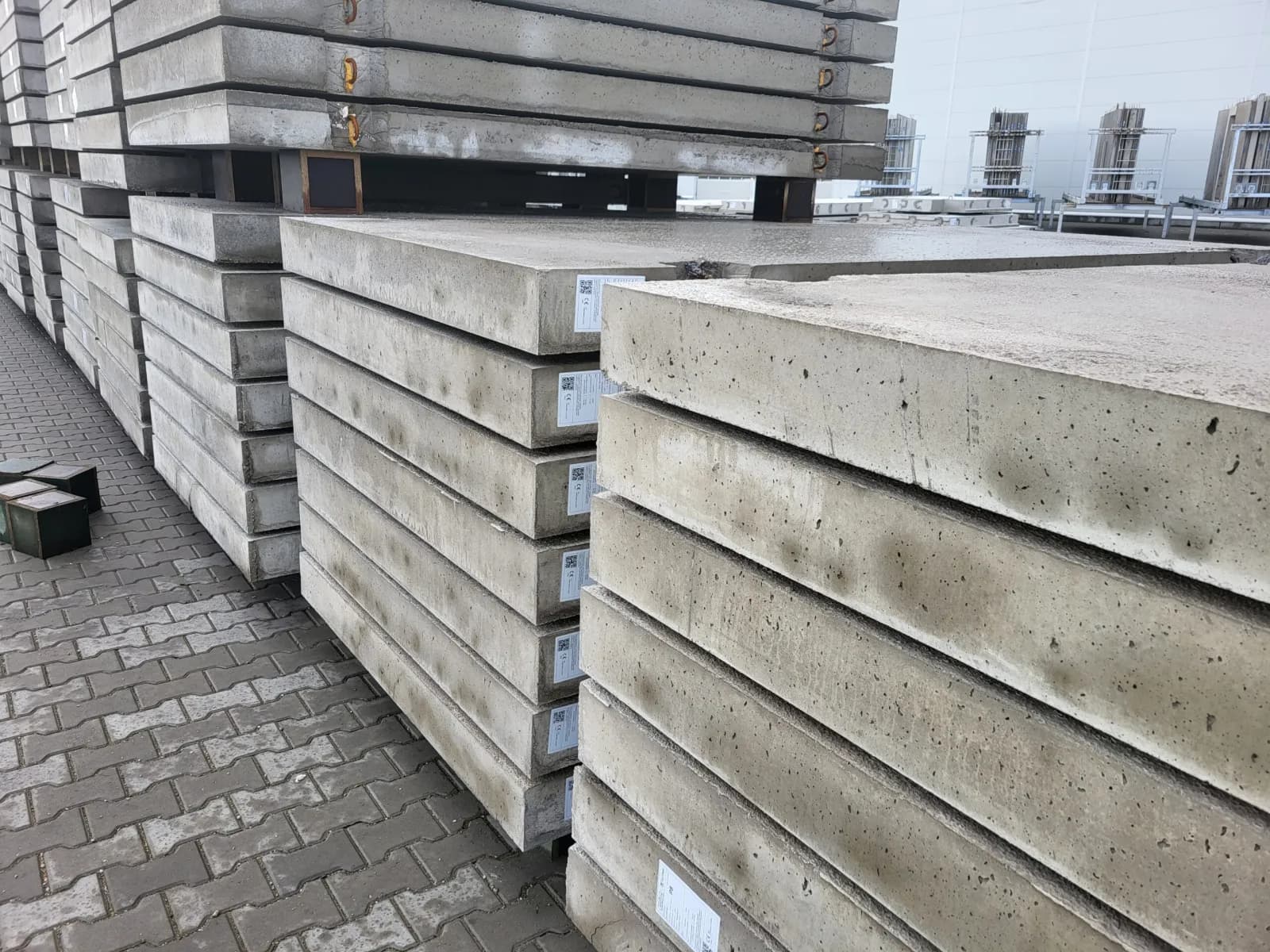
JOMB plates perforated road plates
A surface that lets water through
The JOMB plate is a perforated road plate measuring 100 × 75 × 12.5 cm and weighing around 177 kg. One piece covers 0.75 m² — a square metre takes about 1.33 plates and 236 kg of concrete, far less than with solid plates. The surface load is up to 30 kN/m².
The perforation consists of sixteen oval openings in a 4 × 4 grid, separated by ribs of trapezoidal cross-section. The openings drain rainwater into the ground and let the surface grass over — which is why JOMB works where a solid plate would create a sealed surface needing drainage: on green parking bays, driveways and site roads.
We produce the plates in C30/37 concrete with F150 frost resistance and water absorption up to 5% — values for permanent use; the market's temporary variant also comes in C25/30 and F100. Reinforcement is a bottom mesh of ⌀5.5 B500SP bars (approx. 1.4 kg per plate), or two meshes in the reinforced version (approx. 2.6 kg), with a 30 ± 5 mm cover.
In enquiries the same plate appears as JOMB, jumbo or yomb, and descriptively as a perforated or multi-hole plate. All these names refer to the product described on this page.
JOMB plate parameters
Typical values from the catalogues of repeatable road elements — the same across the industry.
- Dimensions (l × w × h)
- 100 × 75 × 12.5 cm
- Weight
- approx. 177 kg — approx. 236 kg/m²
- Coverage
- 0.75 m² per plate (approx. 1.33 plates/m²)
- Surface load
- up to 30 kN/m²
- Concrete class
- C30/37 · C25/30 (temporary variant)
- Frost resistance
- F150 · F100 (temporary variant)
- Water absorption
- Up to 5%
- Abrasion resistance
- 18 000 mm³/5000 mm²
- Reinforcement
- ⌀5.5 B500SP mesh, approx. 1.4 kg — reinforced version 2 meshes, approx. 2.6 kg
- Cover
- 30 ± 5 mm
- JOMB load is stated per unit area, in kN/m² — some market documents quote a wheel load in kN for the same plates. These are two different measures and must not be compared directly.
- The capacity of the surface also depends on the sub-base — the perforation does not remove the need for a prepared foundation layer.
JOMB or a solid plate?
Two plates for two jobs. They differ in whether the surface should let water through — and in how their capacity is stated.
Where JOMB plates are laid
The common denominator: a surface that must carry traffic but need not be sealed — and often should not be.
Temporary and site roads
A surface for the construction period that can be lifted afterwards and laid on the next site — the plate weight allows work with light equipment.
Driveways and permanent roads
In C30/37 concrete with F150 frost resistance, JOMB works as a permanent surface — on property driveways and estate or internal roads.
Green, permeable parking
The openings drain water into the ground and let grass grow through the surface — parking bays stay green and the plot needs no extra retention.
Storage yards
Hardstanding for storage and internal traffic without an asphalt surface — removable when the area changes use.
What determines the price of precast elements
Precast elements are not priced from a per-metre price list — every element is designed for a specific project, and the difference between two projects of the same floor area can reach several tens of percent. So instead of a rate, we explain what actually determines the figure in your offer.
We prepare a quote within about a week of receiving complete documentation: dimensioned floor plans, sections, elevations and the site location with a postcode. The offer covers production, transport and installation — each item is priced separately, so you can see where there is room for savings.
- Element repeatability
- The single biggest variable. The same element produced in a series is markedly cheaper than a one-off, because the mould and production set-up are spread across many casts. A design based on a few repeatable types works out cheaper than one with dozens of unique elements.
- Concrete class and reinforcement
- A higher class means more cement; higher loads mean more steel. Sizing for the actual loads, rather than with excess margin, can cut the cost without compromising the structure.
- Surface finish
- A smooth, as-cast surface from the mould is standard. Form-liner textures, acid etching or architectural concrete in category BA2 or BA3 require additional formwork and tighter controls, which shows in the price.
- Factory-fitted features
- Cast-in boxes, conduits, openings and corbels increase the element price but remove the cost of chasing and fixing on site. On larger series this usually works out cheaper than doing the work on site.
- Transport and size
- The price depends on the distance and the number of loads. Elements up to 3,85 × 9,00 m travel on a standard vehicle; larger ones require abnormal-load transport with an escort vehicle and permits, which changes the calculation significantly.
- Timing and season
- Production runs in parallel with the groundworks, so ordering early gives flexibility in the programme. Forced deadlines and next-day deliveries always cost more.
JOMB plates — questions
The questions contractors and investors ask most often. Yours is not here? Write to us — we answer specifically.
- What are JOMB plates, and how do they differ from jumbo or yomb?
- They do not — it is the same perforated road plate of 100 × 75 × 12.5 cm, written in enquiries and documents as JOMB, jumbo or yomb. Formally it is a multi-hole concrete plate: sixteen oval openings in a 4 × 4 grid, ribs of trapezoidal cross-section, weighing around 177 kg.
- How much does a JOMB plate weigh, and how many make a square metre?
- Around 177 kg, with 0.075 m³ of concrete. One plate covers 0.75 m², so a square metre takes about 1.33 plates and 236 kg of concrete. The unit weight allows laying with light equipment, without a heavy crane.
- What load do JOMB plates carry?
- The typical value is a surface load of up to 30 kN/m² — both with a single bottom mesh and in the reinforced two-mesh version. Watch the units: JOMB load is stated per area, while solid plates are rated by wheel load in kN. These are two different measures — documents quoting both for the same plates are not directly comparable.
- JOMB or a solid plate — which to choose?
- JOMB is chosen where the surface should drain water or grass over: green parking, driveways and temporary roads with lighter traffic. The solid plate works where wheel-load capacity matters — on site roads and yards with heavy traffic. The expected traffic and the plot's drainage requirements decide.
Documents for this product
Technical catalogue, installation manual, declaration of performance and FPC certificate — what design and handover call for.
- Product tolerances
Permissible dimensional and geometric deviations and surface requirements for precast elements, arranged by product standard: wall elements EN 14992, ribbed floor elements PN-EN 13224, linear elements PN-EN 13225 and others. The basis for accepting elements on site. Version 2026-02, contract annex, in force from 1 January 2026. Document in Polish.
PDF · 7 pages · 0.2 MB
- General installation conditions (OWM)
Scope of the standard installation service and additional works, performance conditions, preparation of the work front, setting out, substrate and access routes, interruptions and standstills, and acceptance. Version 2026-02, in force from 1 January 2026. Document in Polish.
PDF · 8 pages · 0.6 MB
- NORDCERT certificate — precast concrete products (EN 13369)
Certificate no. 2284 issued by Nordcert AB, Stockholm, for the factory production control of precast concrete products group B to EN 13369:2018 with supplementary Swedish requirements (Nordcert CB5). Authorises use of the BBC mark. Międzyrzecz plant, identification PO 24, valid until 31 December 2027.
PDF · 1 page · 0.6 MB
- NORDCERT certificate — ready-mixed concrete (EN 206)
Certificate no. 7316 issued by Nordcert AB, Stockholm, for the production of ready-mixed concrete to EN 206:2013+A2:2021 and DS/EN 206 DK NA:2020. Międzyrzecz plant, valid until 31 December 2027.
PDF · 1 page · 0.04 MB
- Certificate ITB-EPD 561/2023 — normal-weight concrete precast elements
Type III environmental product declaration certificate issued by the Building Research Institute (ITB) in accordance with EN 15804+A2. Issued 1 December 2023, valid for 5 years.
PDF · 1 page · 0.2 MB
- Certificate ITB-EPD 562/2023 — expanded clay concrete precast elements
Type III environmental product declaration certificate for lightweight concrete products, in accordance with EN 15804+A2. Issued 1 December 2023, valid for 5 years.
PDF · 1 page · 0.2 MB
Guides
More about this product
Articles on the decisions that precast takes before production rather than on site.
We'll select the right elements for your project
Send us dimensioned floor plans, sections and elevations — we will prepare an element selection, a schedule and a quote. Preparing a quote takes around a week on average. We deliver and install across Poland as well as in Germany, Czechia, Slovakia, Denmark and Sweden.