Guides
Precast delivery logistics: from plant straight to the crane
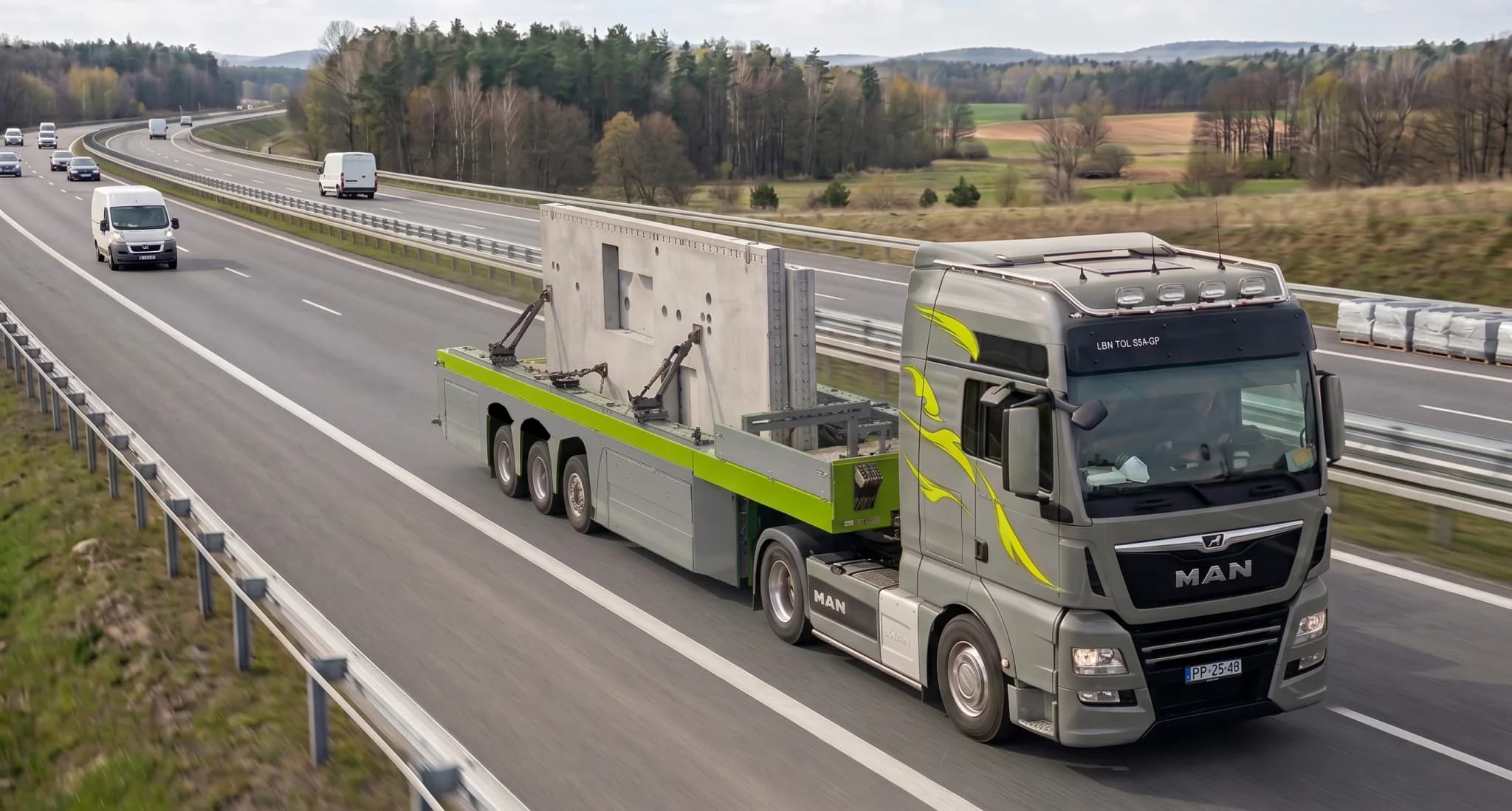
Formee precast elements travel from a single plant in Międzyrzecz to sites within a radius of almost 1,000 km — in Poland, Germany, the Czech Republic, Slovakia, Denmark and Sweden. Twenty to fifty rigs from regular external hauliers leave the plant every day, loaded in reverse erection order so that each element goes from the trailer straight to its final position. An element up to 3.85 × 9.00 m travels on a standard rig; a larger one requires an oversize transport.
Precast has a reputation as a technology that wins in the plant and loses on the road: the element is heavy, long, and has to arrive exactly when the crane is waiting for it. That is true — and it is precisely why logistics is part of the design for us, not a service ordered at the end. This text shows what an element's journey from Międzyrzecz to site looks like, what governs it and what it demands of the site.
From where and to where
All the elements are made in a single plant, in Międzyrzecz in the Lubusz Voivodeship, a hundred kilometres from the German border. From that point we serve sites in Poland, Germany, the Czech Republic, Slovakia, Denmark and Sweden — within a radius of nearly a thousand kilometres. Distance is not a disqualifying criterion, it is a line in the calculation: what counts is the number of trips and the length of the route, and for deliveries abroad there are permits for oversize rigs on top of that.
How much of it is on the road
Twenty to fifty rigs leave the plant every day, depending on how many sites are in the erection phase in any given week. We do not run our own fleet. Transport is carried out by external hauliers we work with on a permanent basis, who between them have a pool of about fifty vehicles — from standard trailers to low-loaders for tall and heavy elements.
We chose the model with external hauliers for one reason: erections are not spread evenly across the year. An in-house fleet would have to be sized for the peak of the season and stand idle the rest of the time, and its cost would end up in the price of every element. A pool of hauliers scales from week to week.
What fits on one trailer
An element up to 3.85 × 9.00 m travels on a standard rig. A larger one — a filigree floor plank, which we produce up to 2.50 × 12 m, or a long beam — requires an oversize transport with an escort vehicle and permits, which materially changes the cost and the lead time of the delivery. That is why we plan the division of the floor plan into elements together with the designer as early as the quotation stage, and not after the design is closed: sometimes moving one division line by a few dozen centimetres is the difference between a standard rig and an oversize one.
The number of elements on a trailer, however, is governed not by size but by mass. Here expanded clay concrete works in the investor's favour: three hundred square metres of wall — as much as a typical storey of a multi-family building from our projects — weighs about 48 tonnes in class LC16/18 and about 70 in normal-weight C20/25. Those twenty-odd tonnes are roughly one rig less per storey. More on this difference in the text expanded clay concrete or normal-weight concrete.
Loading in erection order
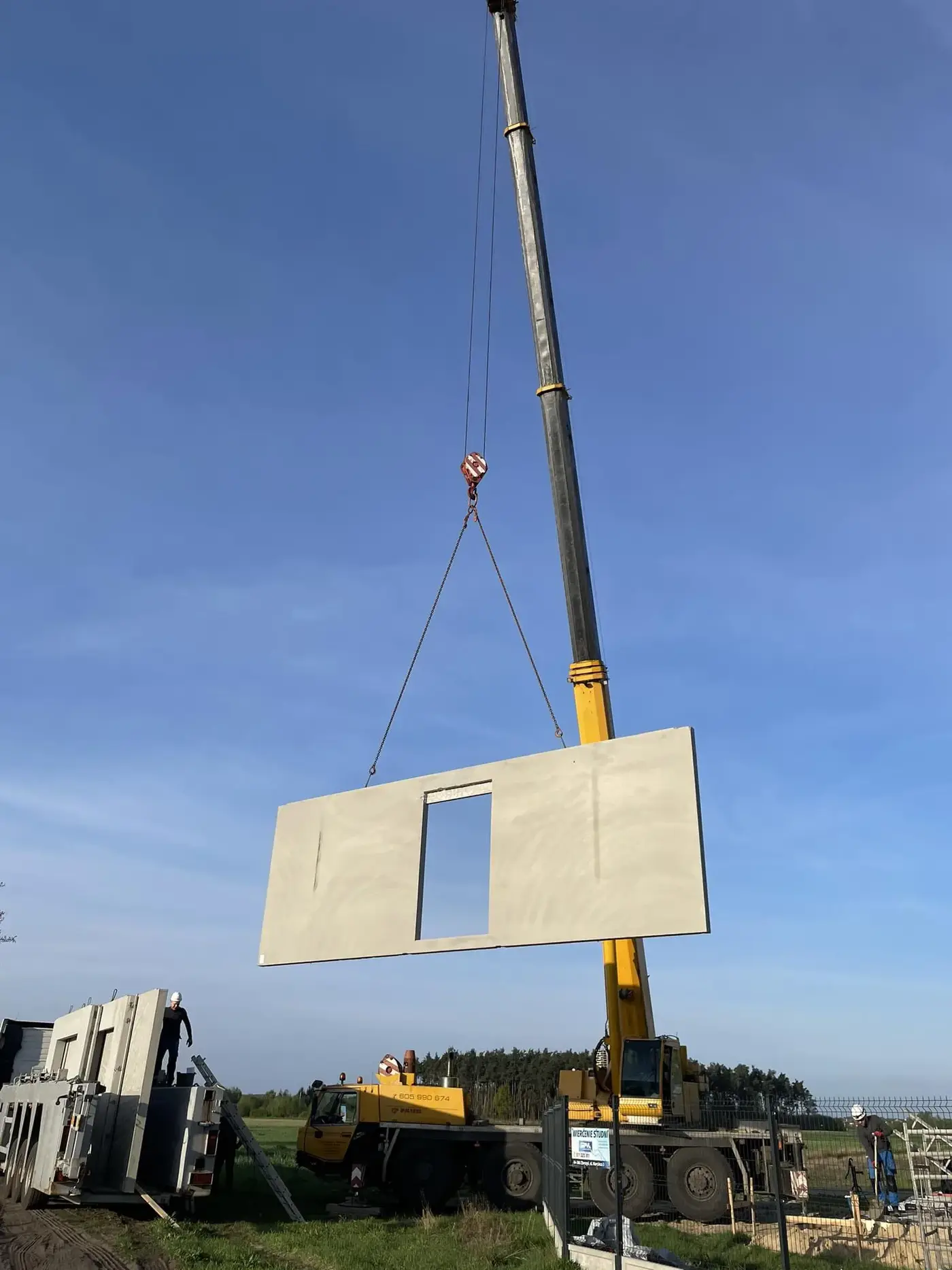
The most important rule is this: the element comes off the trailer straight into its position. We do not store precast on site unless there is a need — storing means an extra lift with the crane, space on the site and a risk of damaged edges.
For that to work, the trailer has to be loaded in reverse erection order: whatever stands first travels on top. The erection sequence is set by our designer together with the erection manager before the elements go into production, and the same list then governs loading at the plant. We plan transport together with the erection sequence, not after it.
This is clearest where there is no choice. At Cienin Kościelny the site bordered the neighbours' buildings, and the access was narrow enough that a rig could neither turn around nor wait. Every delivery had to hit its erection window, because a late rig had nowhere to wait and an early one blocked the access for the next. A site in the middle of a village looked different from one using traditional technology: a dozen or so rig arrivals and a crane, with no materials compound and no weeks of small-delivery traffic.
What the site has to provide
The site has to provide three things: access for a low-loader, a crane position within reach of all the elements, and room for the temporary props. We check this before the contract is signed, not on the day of delivery — the full list, including road bearing capacity and turning radii, is set out in a separate text: plot, access, crane. The course of the erection day itself, from the first rig to the grouting, is in the article how erection proceeds.
Weather and season
An element arrives with the strength it reached in the plant, so delivery and erection do not depend on the curing temperature of concrete. Winter does not stop transport; what stops it, as with any crane work, is wind, ice on the element and visibility. We have erected in November at Człopa and in February at Pudliszki — in both cases the programme stopped depending on what the weather would be and started depending on whether the crane could work that day.
When the date moves
A construction site rarely runs exactly to plan, and that is the second reason an element should not wait on site. Finished elements wait at the plant, and a delivery can be moved by a day without consequences. In traditional technology a postponement means a crew with no work face; here it means a different departure date for the rig.
Where transport sits in the price
In the offer, transport is a separate item alongside production and erection, so you can see what distance costs and what size costs. That item is driven by the length of the route, the number of trips resulting from the mass of the elements, and any oversize transport. What else makes up the price is described in the text how much precast concrete elements cost. We prepare the quotation, including the transport calculation, on the basis of dimensioned plans and the postcode of the site, usually in about a week — ask for a quotation.